Building BNPL service from 0-1
Delivery Hero (foodpanda, foodora), Late 2025–2026

Postpaid allows users spend from a pre-approved credit limit and repay later on a fixed date. It's the first credit product on our platform,
I led the design from discovery through MVP launch and crafted the future roadmaps.
Role
Lead designer
UI/UX design | User research | Regulatory & compliance design | CRM & lifecycle communications
Metrics
Repayment rate
Adoption rate
Default rate
Net incremental GMV
Collaboration
Product Manager
UXR
Product Rollout
Central CRM team
Engineering
Markets
Philippines, Hong Kong, Norway

Result
~3%
lift in platform GMV
~80%
repayment rate
& Best performing default rate among the entities
The opportunity to unlock growth through BNPL
Through a BNPL fake door test in 2022, we learned that users who clicked through ended up ordering 260% more than average in the following weeks. That gave us the conviction to build it, but it also meant we were designing for a new financial service, beyond food and groceries deliveries. In pilot markets, only whitelisted users will have access to Postpaid to assure that the service is not abused.
Research and insights
Our quantitative survey highlighted that despite the interests shown several potential frictions for users to adopt Postpaid.
False assumption of our services
Buy now pay later services come in different payment mechanism and cycles (Pay in 30D, 3 or 6 months). Users had false assumptions based on their understandings or interactions with other credit products.
The fear of hidden charges and high interest
Despite calling out interest-free explicitly, users still anxious about unforeseen charges for using such service
Concept of money in markets differ
APAC users are more open to credit services while EU users are more reserves.
Guiding principles
Build trust through transparency
In fees communications (if any),policy, credit limit and usage across activation, ordering and repayment.
Seamless and supportive
In ordering and repayment journey where payments are involved, it's crucial to ensure the payment is smooth, seamless and users are not left clueless in the case of payment failure.
Driving alignments with stakeholders
The Challenge: Cross-functional stakeholders frequently misunderstood the complex repayment mechanism, leading to circular discussions, invalid assumptions, and stalled progress.
My Solution: To bridge this communication gap, I designed a series of simplified infographics illustrating the product's repayment cycles.
By integrating these visual aids into our presentation decks successfully aligned the team, eliminated confusion, and transformed unproductive debates into actionable, streamlined discussions.

Discovering postpaid
For awareness touch points, we learned from the past research that users typically only think about payment at checkout hence I proposed 2 approaches in driving awareness:
Contextual one-time intrusive prompt at checkout for high-intent users
Permanent touch points in payment selection page and account page for users to access via external communications
Instead of having different onboarding handling in MVP, I proposed having the same onboarding bottom sheet to be triggered at different touch points. This allows the team to experiment more awareness touchpoints in the upper funnel journey in future phases with a reusable component.
One onboarding, multiple touch points.

Checkout
Highest visibility, catches users right when they're deciding how to pay
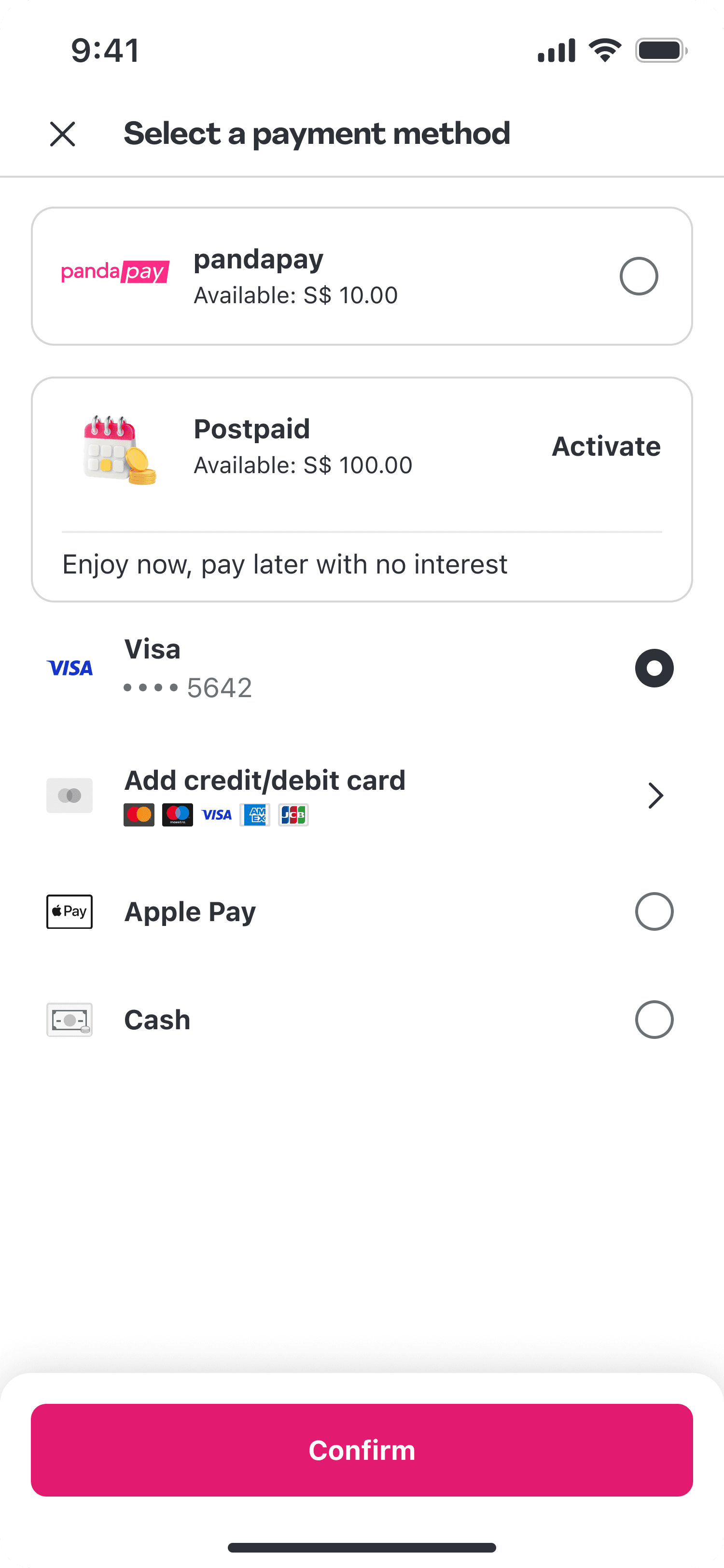
Payment selection page
Reaches user who has intent to change or does not have a default payment method
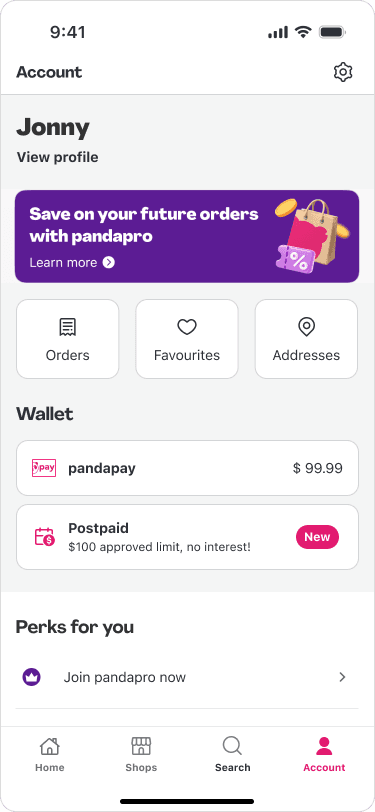
Account - Wallet
Matches where users expected to find postpaid information in moderated interview
Managing postpaid funds
We have wallet services in selected markets across foodpanda, foodora and yemeksepeti. When we expand the financial services to BNPL, I explored multiple design directions in consideration of when wallet and postpaid co-exists in a market or when only one service exists, how would a combined financial management or a separated management experience would be like.
Manage funds in a single view

Manage funds separately

I tested the explorations via qualitative user interview to understand how do our users expect and prefer to manage their different funds:
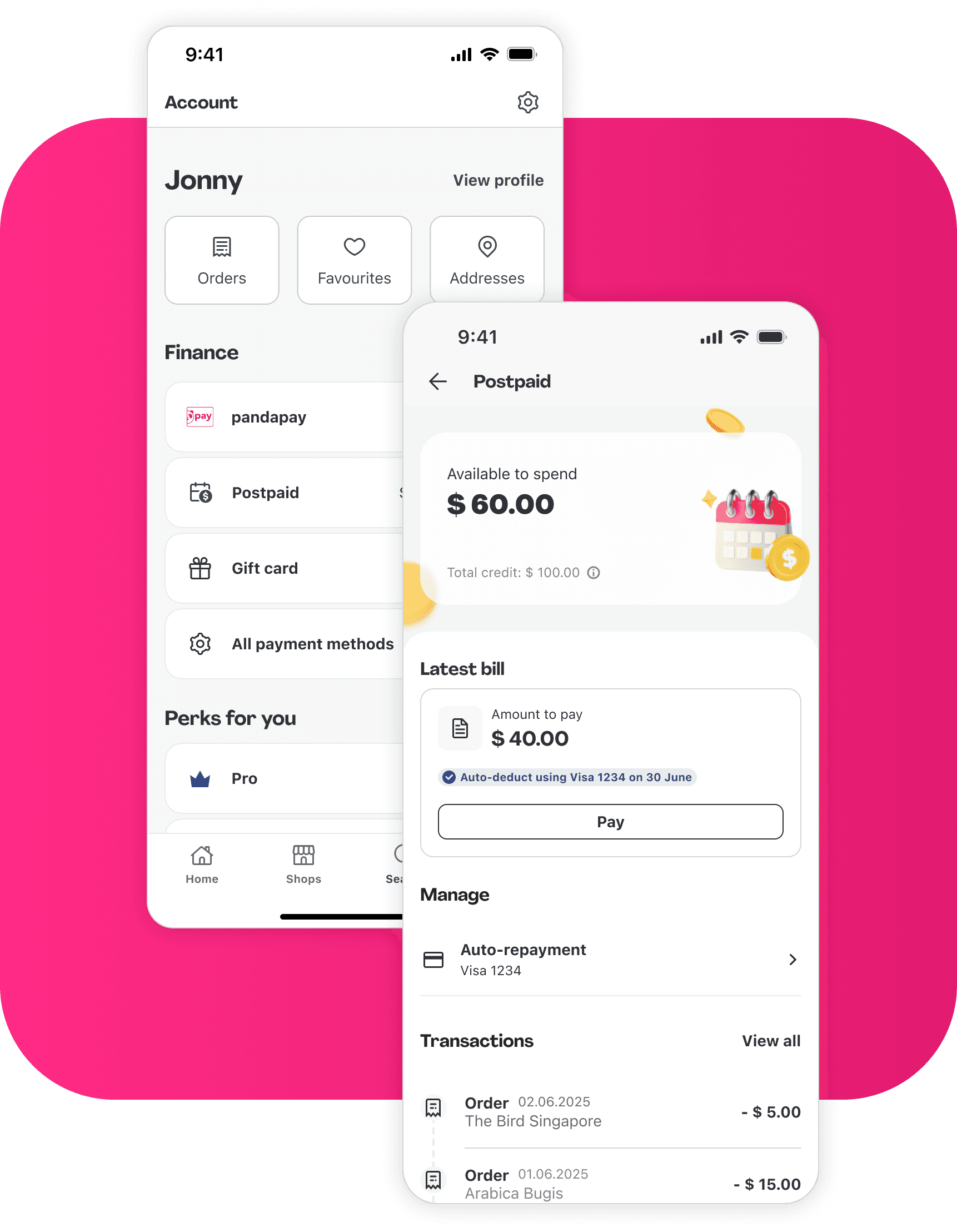
Majority of the users prefer having the financial items being separated in account page.
Overview is clearer on account page
Having dedicated sub-pages allows more focused management
Less distractions
Less complicated when the intent is to manage a single item, user can directly access the details on account page
Managing postpaid bills and repayments
Postpaid management, manual repayment, bill transaction list, transaction history, repayment method management


Intentional friction builds confidence
Initial hypothesis
We assumed that the ideal repayment flow should be as fast and seamless as possible—minimizing steps between opening the app and completing the payment.
What we learned
User interviews uncovered a counter-intuitive reality: friction creates control. Users were hesitant to pay a single lump sum without knowing what was in it, fearing undetected mischarges. They actually preferred a momentary pause to review line items before committing their money.

The solution
Rather than sending users straight to a payment screen, I made the primary entry point open a detailed bill breakdown view. This display showed:
Every unpaid transaction contributing to the current bill.
A full transaction history filtered by billing cycle.
The Impact
By inserting deliberate transparency into the primary flow, we replaced payment anxiety with confidence, giving users full control before they hit "Pay."
Proactive nudges through CRM channels
Since our app isn't part of users' daily routines, there was a high risk of users missing repayment deadlines or key product announcements, leading to unexpected late fees and broken trust.
To bridge this gap, I designed an end-to-end communication framework that aligned user peace of mind with business goals. Then collaborated with local team to localise the content. I established transparent transactional touch points and clear record-keeping to prevent payment disputes and maintain trust.
Multi-Channel Orchestration


Push Notifications & Email
Leveraged for activation nudges and upcoming payment reminders.

WhatsApp (High-Urgency Safety Net)
Knowing that only 60% of users opted into push notifications, I expanded our strategy to include WhatsApp strictly as a last-resort channel for urgent, overdue payments.

Trade-offs & Scoping
As a 0–1 initiative, despite having generated many competing ideas. To efficiently test user appetite and market adoption for a new platform BNPL offering, I scoped the project down to an essential baseline experience (MVP). This core experience focuses on three non-negotiables: frictionless postpaid transactions, effortless repayment and transparent communication.
Additional concepts were staged into a phased roadmap targeting two primary goals:
Accelerating user adoption
Improving repayment rates
By monitoring initial launch metrics, the team is positioned to iterate quickly and roll out targeted, fast-follow enhancements based on real user behavior.
Learnings
Designing a credit product meant almost every decision touched legal, risk, or a communications constraint.
Bringing legal in early helped, but it didn't make the topic go away. A market-specific wording concern still came back close to launch, and I had to iterate fast without slipping the date. That's the part I'd underline most: bringing in the right people early reduces the size of the problems that show up later, it doesn't remove them, so being able to move quickly when something does come up mattered just as much as the upfront planning. We had many rounds of design reviews with the team to make sure the ins and outs were aligned. As a new product service, I also needed to evaluate carefully into what is absolutely crucial in the first launch, managing scope and deliverables.